Hedd Audio has launched the Type 40 Main and Type 40 System studio reference monitor loudspeakers for private mix rooms, mastering suites, postproduction facilities, larger control rooms and high-end listening spaces.
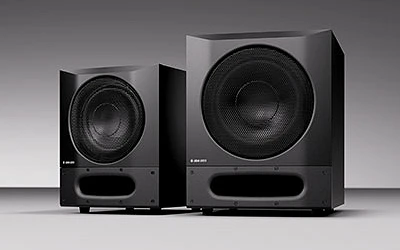
At the centre of the offering is the Type 40 Main, a compact, sealed three-way active monitor that provides full-range reference monitoring from a single cabinet, with no separate subwoofer required. One to three Type 40 XTD modules per channel can then add output, low-frequency headroom, and control over bass radiation without replacing the Main.
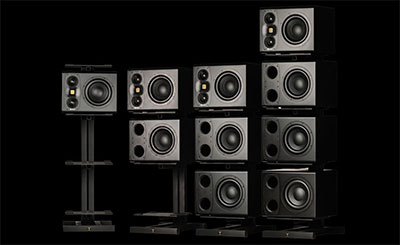 The Type 40 Main uses a sealed enclosure and high-excursion woofer, providing response down to 20Hz. Two 4-inch midrange drivers flank Hedd’s hand-built Air Motion Transformer in a symmetrical D’Appolito MTM arrangement, creating a focused acoustic centre, an even horizontal listening window, and controlled vertical dispersion. Dedicated class-D amplification provides output up to 123dB SPL (peak), combining main-monitor headroom with precise imaging and resolution.
Every Type 40 System configuration retains the Type 40 Main as its reference monitor. XTD modules add low-frequency capability, playback level, and directional control without changing the fundamental monitoring character. Studios can install the capacity they need and expand later as the room, listening distance, or workload changes.
Each self-powered XTD contains a 10.57-inch high-excursion woofer and a 700W class-D amplifier. Up to three modules can be installed beneath each Main while preserving a modest footprint. The XTD modules can be physically changed between Ported and Closed operation by installing a special port cover. In frontfire ported operation, three XTDs increase maximum SPL at 50Hz by up to 15dB compared with the Main alone. Ported Mode prioritises efficiency and maximum output; Closed Mode prioritises low-frequency control, definition and resolution.
Selectable Cardioid configurations reduce energy behind the Type 40 System, limiting reflections from the wall behind the monitors that can build up and blur the low end. This is particularly useful where room geometry, speaker placement, or acoustic treatment cannot fully control low-frequency behaviour.
Depending on the configuration, rearward radiation can be reduced by up to approximately 10dB. A single Cardioid Closed XTD provides directional control from approximately 20Hz to 200Hz, while larger systems can combine Frontfire modules for output with a Cardioid module for room control.
The Type 40 Main and every connected XTD operate as one time-aligned monitoring system. In Zero Phase mode, Hedd Lineariser corrects amplitude and phase response and aligns the system in time for a coherent impulse response. Flat retains frequency-response correction without phase linearisation, while Off provides the lowest possible latency for tracking and real-time performance.
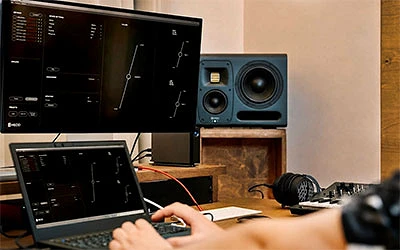
Hedd Ctrl manages every Main and XTD through a single interface over Ethernet. Once the physical configuration and XTD operating modes are selected, it applies the correct LF Range and Extension Qty settings automatically. Engineers can manually correct the room from the listening position using 12-band parametric EQ at group and individual-speaker level, and save presets for different workflows, formats, clients, or listening positions. Hedd Ctrl can manage a stereo pair or an immersive installation of up to 250 loudspeakers.
A pair of Type 40 Mains provides a complete full-range reference where a traditional large-format system would be impractical; XTD modules extend it where greater output, low-frequency headroom, or cardioid bass control is required.
The Type 40 Main can be placed horizontally on stands, integrated into soffits or installed with compatible mounting hardware. XTD modules expand vertically beneath it, allowing the system to scale around consoles, screens, room architecture and immersive channel layouts.
More: www.hedd.audio