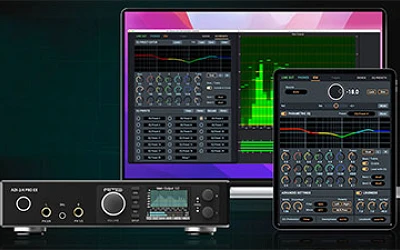
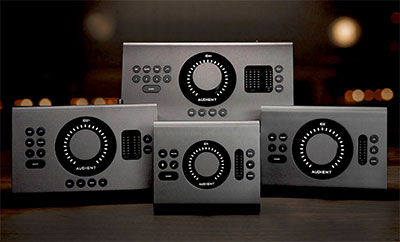
Audient has launched the Next-Gen iD Range, the third generation of its iD desktop audio interface family. The range comprises the iD1, iD2, iD2+ and iD4+, sharing the same engineering platform in a compact, bus-powered format for the home producer, singer-songwriter or hybrid engineer working from a desktop.
The difference between models is in the interface. Powered by Audient’s Analogue Intelligence, the technology platform inside every iD Mk3, real analogue at the front of the signal chain, from the flagship ASP8024-HE console. Onboard DSP behind it sets the levels, correcting the room and running the effects.
 ‘With the next-gen iD range, we’ve built a range around four things most interfaces in its class can’t offer – real analogue preamps, built-in RoomTune Monitor Correction, onboard DSP FX and a discrete Analogue Tone Suite,’ says Audient Chief Product Officer, Andrew Allen. ‘This isn’t a spec refresh; iD is a completely new technology platform built on our Analogue Intelligence Platform.’
All interfaces in the line-up feature Audient Console Mic Preamps with 75dB of clean gain (the same discrete Class-A preamp design from the flagship ASP8024-HE console); onboard RoomTune Monitor Correction; the Analogue Tone Suite comprising Orbit, HMX, Lift and Glow; hardware-accelerated DSP FX for EQ, compression and reverb with zero latency; 32-bit conversion with 128dB of dynamic range; and full performance over USB-C bus power; digitally recallable analogue and Smartgain for recalling sessions and setting levels.
All four interfaces support Mac and Windows, up to 192kHz
‘We also took the opportunity to simplify the naming,’ says Allen. ‘The new iD naming reflects the number of preamps in each model – one, two or four. The plus models add features for more integrated studios: balanced hardware inserts, Adat input and output and advanced monitor control. Anyone coming from an iD4, iD14, iD24 or iD44 will find the iD1, iD2, iD2+ and iD4+ Mk3 respectively.’
The iD1 (formerly iD4) is designed for the solo musician and offers a 2-input/2-output interface with one Audient Console Mic Preamp and a JFET Instrument Input, usable simultaneously so vocal and guitar can land in the same take. The iD2 (formerly iD14) targets the home producer stepping up with 10-input/6-output capability and two Audient Console Mic Preamps, Adat expansion for eight more inputs and Pro Monitor Control with two loudspeaker outputs.
The iD2+ (formerly iD24) is for the producer building an integrated studio, a 10-input/14-ouputt interface with two Audient Console Mic Preamps, two balanced hardware inserts on Channels 1 and 2, and eight channels of Adat in/output. A RM1 Reference Microphoneis included.
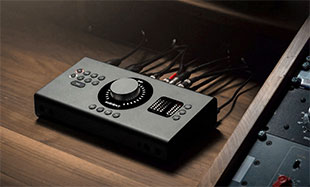 The iD4+ (formerly iD44) is for the engineer running high-channel-count sessions, offering 20-input/24-output interface with four Audient Console Mic Preamps, two JFET Instrument Inputs, two balanced hardware inserts and 16 channels of Adat in/output. Two independent headphone amplifiers with up to four cue mixes. Again, a RM1 Reference Microphone included.
RoomTune is Audient’s new proprietary monitor correction software, free with every iD interface. It corrects your monitoring for the room at the hardware level using the interface’s onboard DSP (no plug-ins, no CPU load). Because the correction runs on the interface, the calibration applies system-wide: every application benefits, from DAW to Spotify.
At launch, RoomTune provides stereo monitor correction for the interface’s loudspeaker outputs. Headphone correction and additional target profiles are planned as a free future software update. RoomTune requires the RM1 Reference Microphone, included with the iD2+ and iD4+ , sold separately for the iD1 and iD2.
The Analogue Tone Suite gives every iD Mk3 four dedicated tone shaping tools designed to shape sound at source before the signal hits the DAW.
Orbit is a discrete analogue circuit – a variable impedance control that physically changes how your microphone responds to the preamp, reshaping tonal character from airy and modern to weighted and vintage. HMX is a discrete analogue circuit that adds harmonic saturation through a custom MOSFET – weight for thin kicks, body for clean guitars and the low-end thickness of a classic valve console. Lift lifts the high frequencies with the kind of expensive sheen vocal engineers chase in the mix. Glow combines HMXTM and Lift in a single move providing saturation for the low-mids, sheen for the highs.
The next-gen iD interfaces introduce a new industrial design across the range – a sloped top panel for easier at-a-desk control, a stepped metal encoder that clicks into place for precise, repeatable gain settings and back-illuminated LEDs and metering that stay readable in any lighting condition.