

 It began with the playback of a seminal album and accompanying talk from the engineer who oversaw its making back in 1987/8, followed by an evening with a record producer with an illustrious career spanning six decades a mere four days later. The following weeks brought two further talks and two autobiographies, adding up to a fascinating ride through the music business led by people with major roles to play.
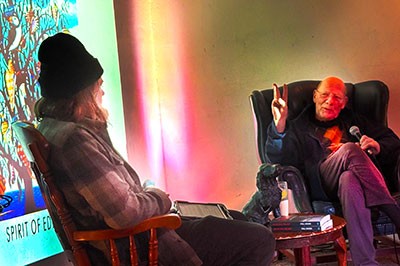
The opener – the latest in the Long Play Sessions programme – focused on Talk Talk’s Spirit of Eden album (played uninterrupted off vinyl through an EM Acoustics system) and the man who presided over its remarkable recording, Phill Brown. Yet to come were an evening with veteran producer Stuart Epps, engineer/producer Ed Buller telling all about the making of Suede’s debut album, the reading of Phill’s autobiography and the hot-off-the-press Ducking and Diving autobiography of recording engineer Louis Austin, and finally a Dolby Atmos playback of Hauntings, the latest album from Japan/Porcupine Tree sound sculptor Richard Barbieri. All but the last of these events took place in Brighton… we get a lot of music down here.
When I had a busy interview schedule in the latter half of the 1980s, I quickly discovered that there was a distinction between those artists who were fresh and those who had been around for a while. The hot ones often didn’t understand much beyond what they were doing, while the cooler ones had valuable perspectives and insights to share. These recent events were all resolutely of the ‘cool and considered’ school.
 I had interviewed Talk Talk’s Mark Hollis and producer Tim Friese-Greene at the time of the release of 1986’s The Colour of Spring. A career high commercial success, it made the following Spirit of Eden possible but had set high expectations. On its completion, the record company hated it and Eden was initially ‘put on hold’.
The recording sessions – at London’s Wessex Studio One – were unorthodox and painstaking, and placed considerable strain on those involved.
Yet it went on to sell 500,000 copies and has since become an inspirational work. And it ultimately resulted in more offers of work than any other Phill has worked on – including, Phill notes in his book, Dido’s No Angel debut album that sold in excess of 16 million (ten times Platinum).
That profoundly rainy evening at Brighton’s Rose Hill Tavern extended a rare privilege to a gathering of knowledgeable and enthusiastic fans to dig into the making of a recording that soaked up 40 reels of Ampex 456 2-inch, 24-track tape and nine months of studio time. Phill spoke, as Richard Barbieri would later, with a rare mix of eloquence and frankness about the Spirit of Eden project and its long-tail fallout. Phill would go on to the subsequent Laughing Stock and Talk Talk frontman Mark Hollis’ solo album – both of which, again, proved difficult in their making and, in the case of Hollis’ solo album its release too – as well as being brought out of retirement to work on David Joseph’s Talk Talk/Mark Hollis-inspired Held By Trees project, that involves many of the musicians that worked on Eden.
The evening covered more than just the Eden recording, extending into Phill’s other work and anecdotes, most entertaining of which concerned a 2-inch tape edit that suffered a near disaster ‘spliff mishap’ in 1973 at Basing Street Studios (formerly Island Studios and HQ of Island Records, and later to become Sarm West under Trevor Horn) during the recording of Bob Marley and the Wailers’ ‘I Shot the Sheriff’.
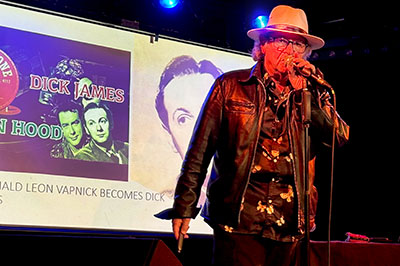 A scant (and less inclement) four days later, I settled into an evening with Stuart Epps at Brighton’s Komedia. One of his ongoing Behind the Music talks, he took his audience on an engaging journey that began in 1967 – the same year as Phill – at Dick James Music studios in London and led him to work extensively with the likes of Elton John, Kiki Dee, Chris Rea, Led Zeppelin and George Harrison.
His relationship with Elton John and Gus Dudgeon began early on at Dick James Music – when Elton was still Reg Dwight – and saw him become assistant and then full engineer. Stuart was also involved in Elton’s Rocket Records, as well as touring with him. He was also key to setting up Dudgeon’s Mill studio at Cookham in Berkshire, as head engineer, where with Dudgeon involved in the design of its 42-Channel MCI mixing desk.
Originally, this was expected to take six months at an outline cost of around £200,000. However, it took two years to complete and cost nearer £1m. It was here that Stuart worked on projects (and sang on some) with George Harrison, Bill Wyman and Paul Rodgers, as well as Chris Rea. The studio ownership subsequently passed to Rea before closing.
Currently, Stuart’s Epps Record Company is on ‘a mission is to discover, develop, and promote exceptional musical talent’ and got an airing here. Along with the benefit of his considerable experience and expertise, it aims to support artists at every stage of their career including with music production using his recording studio, artist development and vocal coaching, and music distribution.
A broad career journey rather than Phill’s unwrapping of a specific project, this talk was littered with both insight and anecdotes, and was an equally unique opportunity for his audience to look into the record-making business and get answers to their own questions.
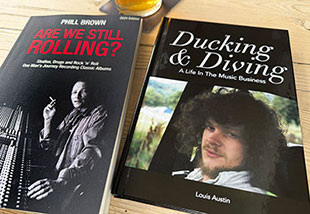 With Ed Buller’s forthcoming Suede talk now part of the agenda but a short while off, I picked up Phill’s Are We Still Rolling autobiography (ISBN 978-1-914066-43-6) – and it’s quite a read. How you have a career that’s so eventful and enduring, and are able to document it in this level of detail defies me.
Presented in diary form, it navigates a remarkable course that began at Olympic Studios in London in 1967, and follows it through Phill’s wide-ranging work in an industry that evolves relentlessly on both technical and business fronts in an amazing amount of detail.
As well as a journey through Phill’s life and work, it’s a study of the music that accompanied it, the industry that both supported and exploited those involved in making and recording it, and a document of recording technology’s evolution.
There is a great deal to be learned here, particularly in the selection and placement of microphones, musicians’ positioning in the studio, mixing desks and their evolution, musicians and studios – and the drug taking common within the business.
Concluding Are We Still Rolling, Phill reflects on what his book is and what might have been, included with this note: ‘There could certainly have been more technical information about recording, but that is not the reason for this book. It’s about the emotional reality of sessions and remembering a period of time that had discipline, performance and anarchy.’
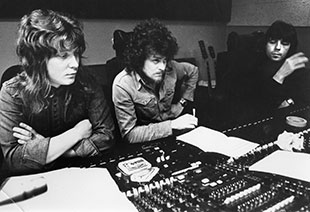 Louis Austin’s book made its appearance while I was working through Phill’s, and was a neat fit into what had now become a ‘project’. Both begin with their respective authors in hospital, though for very different reasons.
Louis’ entry into the world of recording studios began a year after Phill’s, in 1968 at London’s De Lane Lea. It follows Lou’s time recording the likes of Queen’s first album, Def Leppard, Deep Purple, Michael Schenker Group, Fleetwood Mac, Ian Gillan, Leo Sayer and several Judas Priest albums, as well as the soundtrack for The Wicker Man.
Louis was central to the acquisition and re-opening of De Lane Lea’s Kingsway premises as Kingsway Recorders with Deep Purple’s Ian Gillan, where he was to record Sweet’s ‘Fox on the Run’ in 1975, the first song written and produced by the band. He had also designed The Hot Wax Mobile in 1974 for Cliff Davis, by this time Fleetwood Mac’s former manager, along with its custom Raindirk console.
Ducking and Diving also covers abandoning the studio for ventures into marketing with The Home Service, PR (primarily for Genelec) and photography – as well as devoting its closing 40-page afterword to the cars that Louis says sparked the idea for writing it.
 It is a highly entertaining read, shorter and lighter than Phill’s, and carries its own nuggets of discovery… ‘it wasn’t until March 1989 that beer became legal in Iceland – a day now celebrated as Bjórdagurinn’. Although both UK folk, this and Phill’s book have a strong international angle, Louis’ fuelled by his PR work and his wanderlust.
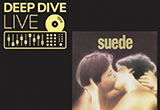
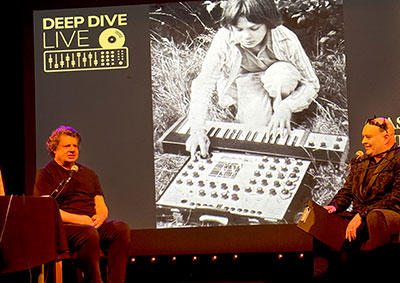
My reading done, the first of a planned series of Deep Dive talks then saw Ed Buller take the stage at Brighton’s The Old Market, armed with Cubase stems on of Suede’s debut album multitracks.
With Tangerine Dream as his first favourite band, Ed had mastered the EMS Synthi AKS synth aged eight, making the one at Reading University do things its intended users could not. Following a stint as keyboard player with the Psychedelic Furs playing on two albums (although, ironally, not Talk Talk Talk), his move into engineering and production began at Island Studios – somewhere Phill called home for a substantial period early in his career. The two also shared experience of working with, and learning from, Tim Friese-Greene.
Released in 1993, Suede was among the albums that defined Britpop, along with Pulp's 1994 breakthrough album His 'n' Hers – which Ed also produced – and releases from Oasis and Blur.
Ed gave a considerable insight into the album’s making at Master Rock, talking exactingly about the recording process, flatteringly about the band’s working dynamic and talents, and frankly about their personalities to a very knowledgeable audience. Deconstruction of the recording was supported by soloing of individual tracks – a very welcome and helpful tool given the ‘thousand-layer’ style of recording used – particularly for Bernard Butler’s guitar work. The Q&A session inevitably drew him into discussing the events surrounding Butler’s departure during the recording of Suede’s follow-up, Dog Man Star, after a dramatic ‘him or me’ ultimatum delivered to Brett Anderson over Ed’s involvement.
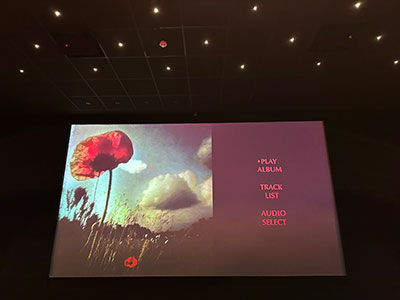 Continuing the intimate feel of the earlier talks, Richard Barbieri introduced a Dolby Atmos playback of Hauntings at London’s Soho Hotel, and then returned to field questions. As well as giving more direct responses to specific questions, he spoke freely and involvingly about ‘finding his voice’, his working processes and what he aims to bring to other artists’ music.
Searching for fresh inspiration following his lockdown Under a Spell album, the spark for Hauntings came in the form of John Koenig’s Dictionary of Obscure Sorrows (ISBN 978-1-5011-5364-8), a book that seeks to ‘coin and define neologisms for emotions not yet described in language’. Propelling Hauntings through a swift two-month recording process, the book directly produced the track ‘Anamoia’ – ‘feeling profound nostalgia for a time, place or era that you have never actually experienced or lived through’.
Richard was to give two further playback evenings supported by improvised performances at other venues on subsequent evenings, and Stuart’s Behind the Music talks continue to tour the country, while further Deep Dive events promise more sessions in a similar vein.
On reflection, the time seems right to add in-person events like these to the wealth of on line information out there. I’d strongly advise taking advantage of anything that comes your way.