

 Among the ‘effects’ consistently used in recording, reverberation is likely the one that has best reflected advances in technology. From acoustic spaces in nature and architecture through loudspeakers and mics in physical rooms, to electro-mechanical processes and on to many iterations of electronics and code, each has introduced its own character and control parameters to the party.
Reverberation made its transition from nature into the recording studio in the late 1940s, when engineers first set up mics in hallways and bathrooms to exploit their acoustics. Producer, studio owner and Universal Audio founder Bill Putnam laid an early milestone with his use of a studio bathroom to add ‘artificial reverb’ to the Billboard No.1 instrumental, ‘Peg o’ My Heart’, by the Harmonicats in 1947.
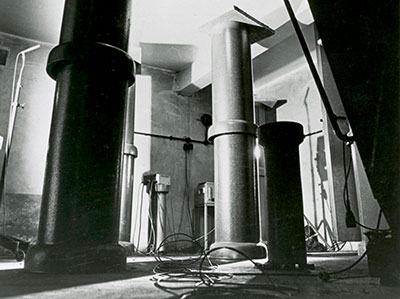 One of the 1950s pioneers of recording with reverb was Joe Meek, often lauded as the UK’s first fully independent record producer and the man behind the Tornados’ ‘Telstar’. As well as building a lot of his own equipment – including a spring reverb, described by Adrian Kerridge who worked with him at the time as ‘probably the first spring reverb unit of its kind’ – he freely used room reverberation from around the Holloway Road house in London where he lived and built his studio.
Dating to the mid-50s, Abbey Road’s storied Studio Two established a dedicated echo chamber when EMI technician Henry Clark and Abbey Road engineer Stuart Eltham repurposed a WWII air raid shelter. Still in use, its place in music history is assured due to recordings by The Shadows, The Beatles and Pink Floyd, among many others.
The 1940s and ’50s saw spring reverb appear, initially on pre-B3 model Hammond organs. Intended to simulate the natural reverb associated with cathedral pipe organs at a time when churches were being made less reverberant to improve spoken word intelligibility, these ‘tanks’ made the transition to guitar amplifiers when licensed by Fender. They appeared in the Vibroverb in 1963, quickly followed by the Twin Reverb alongside its established tremolo/vibrato effect.
Spring Theory
Hammond engineers Alan Young, Bert Meinema and Herbert Canfield had developed the ‘necklace’ reverb from which the Accutronics Type 4 used in these amps was derived, in 1959. Initially, they hung transmission springs loosely from a frame – resembling a necklace – before mounting them under tension in a tank.
This enduring design has made its appearance far and wide, from the Hammond organ for which it was conceived, through countless guitar combos and amps (including the Burns Orbit 3 and Carlsbro Marlin 1042 PA amplifier that provided my first encounters with spring reverb), to modular synth systems from the likes of Moog and Buchla, and to Roland’s classic RE-series tape delays. The Accutronics Type 4 reverb tank is presently still manufactured by Korean company, AccuBell Sound.
Springs also brought with them the first subversion of reverberation, as they were vulnerable to physical impacts that resulted in transient noise made by movements of the spring itself – microphonic noise – often termed drips, splashes or bangs at the output. From keyboard players rocking Hammond organs to guitarists booting combo amps, springs brought a new live performance tool to the stage.
The ongoing appeal of spring tanks is evident in the stompboxes that, rather than looking to other technologies to replicate them, continue to use them – the Carl Martin Headroom, Echo Fix EF-P2 Analogue Spring Reverb, Crazy Tube Circuits White Whale, SurfyBear Reverb and Source Audio True Spring among them. And while presented as a board friendly pedal, the Element Analog Spring Reverb takes the form of a stompbox that connects to a separate spring tank that can be hidden beneath a board.
If you’re a spring purist, you’re being well looked after.
The EMT 140 plate duly arrived in 1957; a large, complex and costly unit weighing 600lb. Made by German manufacturer EMT and now highly sought-after, this uses a central driver to make a 8ft x 4ft steel plate vibrate rather like a loudspeaker mechanism. Two pick-ups recover the signal, while a parallel damper plate gives control over reflection time. Plates were smoother and more natural sounding than Hammond’s springs but, unlike the Accutronics spring tank, are no longer made.
 Analogue electronics didn’t have much to offer the reverb world as this required a huge number of bucket brigade (BBD) chips, as well as complicated audio routing and mixing. Nevertheless, DOD’s 1985 FX45 and the Arion SRV-1 pedal that followed demonstrated what was possible with the technology of the day – which turned out to be not so much.
It fell to EMT to launch what is widely regarded as the first digital reverb unit in 1976. The EMT 250 employed 400 ICs to run algorithms emulating the behaviour of three-dimensional acoustics, along with echo, stereo phasing and chorus effects. Now also highly sought-after, EMT 250 production ran to just 250 units, costing a cool $20,000 at the time.
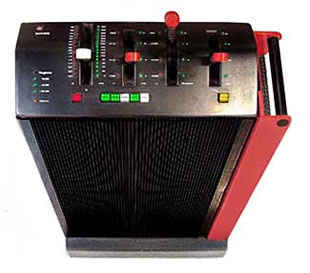
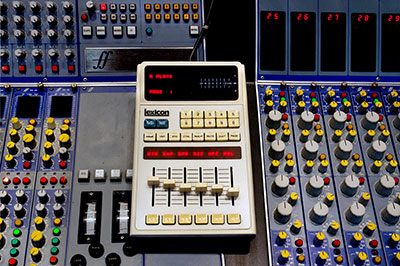
In 1979, US company Lexicon rewrote the digital reverb market with the launch of the Model 224. This was a rackmount unit with the LARC (Lexicon Alphanumeric Remote Control) providing remote operation – a familiar sight on most major recording studios’ mixing desks of the time. It cost about half the price of the EMT 250, and offered eight reverb programs, including Plate and Concert modes. Quickly adopted by the likes of Vangelis, Brian Eno, Vince Clarke, and Peter Gabriel, it played its part in shaping albums including Remain in Light, Hounds of Love, The Final Cut and The Unforgettable Fire.
Launched by AMS (now AMS-Neve) in 1981-82, the RMX16 was the first full-bandwidth digital reverb to appear, using groundbreaking, microprocessor controlled 32-bit DSP to generate algorithms including the NonLin2 gated reverb preset that shaped the distinctive drum sounds of Peter Gabriel and Phil Collins. Through its reincarnation as an AMS-Neve 500 series unit and a UAD plug-in, as well as other plug-ins that have presets ‘inspired’ by the original, it remains a relevant studio reverb option.
In the mid-1980s, Lexicon introduced the still more affordable rack-based PCM Series with the PCM-60. And in the 1990s, the LXP series brought the cost of a versatile reverb effects processor within the reach of project studios, with later models offering multi-effects and a Midi interface. Again, these reverbs are now available in plug-in format as the PCM Native Reverb Bundle and the LXP Native Reverb Bundle.
Boss upended the playing field in 1987 by following the DD-2 and DD-3 digital delay pedals with the RV-2, stereo digital reverb pedal, and the first to translate a studio rack effect into a stompbox. With this, guitarists, keyboard players and home studios had access to room, hall, plate and gated verbs of unprecedented quality – and also a delay. The RV-2 may have been a little ahead of its time, however, and its innovation was not reflected in its commercial performance.
In the years since, technology has allowed surprisingly capable reverb stompboxes to become progressively more affordable – and, therefore, widely used. There are more of these than there are reflection paths in a cathedral; notable among them the Meris Mercury 7 was inspired by Vangelis’ shimmering Lexicon 224 treatments from the Blade Runner movie soundtrack.
Impulse Power
In 1999, the Sony DRE S777 introduced us to real-time convolution. This ‘acoustic photography’ uses impulse response recordings (IRs) of a specific real space – such as a concert hall or studio live room – to capture its behaviour as a set of IR samples. These then provide the platform for convolution to impose the space onto audio. The DRE S777 was another milestone in artificial reverb.
 In 2007, former Lexicon employees Brian Zolner and Casey Dowdell disregarded convolution processing for the Bricasti Model 7. A 24-bit, 192kHz digital design, this is based around a DSP engine comprising six dual-core Analog Devices DSPs to produce reverb, that has proved stubbornly popular, particularly among FOH engineers. While candid about its design, Zolner once made a distinction to me between reverbs he regarded as ‘effects’ imposed on an audio signal and the M7’s creation of a reverb ‘environment’.
The use of gated reverb on Phil Collins’ ‘In the Air Tonight’ is a further example of reverb subverted from its roots in the physical world. This was recorded in the Stone Room booth at London’s Townhouse Studios, designed by Virgin Records Technical Director, Philip Newell, inspired by his experience of recording in locations such as English castles. The drums were recorded with two Neumann U87 mics and then compressed with Urei 1176 compressors and the reverb tail strangled using the gate on an SSL console. Reversing and freezing reverb are further examples of the ways in which reverb can be divorced from the real world. Where reverse switches the reverb tail to the front of the effect, freeze loops it to create a pad. And then there’s shimmer…
Shimmer, as devised by Brian Eno and Daniel Lanois in the studio, and closely associated with U2 guitarist The Edge. This employs pitch shifting and reverse reverb, and can be now found as dedicated programs in numerous reverbs including Strymon’s BigSky and blueSky, Bananana Effects Abracadabra, TC Electronic’s Hall of Fame, and Eventide’s Space and H9 pedals. Alternatively, TC and Neunaber’s Fluorescence and Seraphim are dedicated shimmer pedals.
Some of the most extreme acts of subversion can be found in MangledVerb, a program found in Eventide’s Space that promises ‘lush reverbs and ripping distortion to create sound-sculpting musical chaos’, one of four stompbox-style effects that marked Eventide’s first moves to expand its studio technology to the musicians’ world in 2011, along with the TimeFactor, PitchFactor and ModFactor. The scope of Space is such that – alongside excellent spring, plate and rooms – the creative palette offered by MangledVerb has won it a place with sound designers working in film and TV.
As is characteristic of technological advance, what was once the exclusive province of the elite, reverb has progressively opened up to a very broad user base. This is most pronounced with plug-ins using the hardware and software of a host computer (or server) to run their code, making their material overheads trivial. And in keeping with this ‘democratisation’, they are legion.
A sample of the plug-ins to be found might include Soundtoys’ Little Plate/SuperPlate and Valhalla’s VintageVerb for classic reverbs, FabFilter’s Pro-R for an interface that simplifies complex reverb shaping, Audio Ease’s Altiverb 7 for convolution reverbs, the SSL ‘Verb’ collection (featuring SpringVerb, PlateVerb and GateVerb) and Eventide’s Blackhole and Blackhole Immersive for extreme spaces.
 From the IR stable, plug-ins bring some of the world’s most iconic recording studios’ reverb to DAW recording. Among these are the UAD Sound City Studios and Universal Audio Ocean Way Studios plug-ins, as well as Spitfire Audio’s AIR Studios Reverb, created in collaboration with London’s AIR Studios using proprietary Virtual Positioning Technology to allow sounds to be positioned anywhere in Lyndhurst Hall.
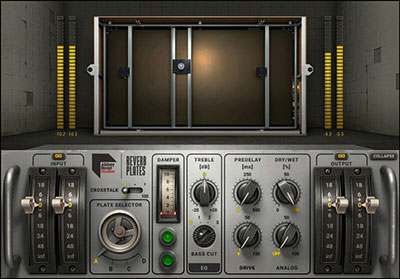
The chamber at Abbey Road is enjoying renewed favour as Waves’ Abbey Road Studio 3 plug-in, alongside the Abbey Road Reverb Plates plug-in, modelled on the studio’s four customised EMT 140 plates installed in 1957 and still in use.
IK Multimedia offers Sunset Sound Studio Reverb and The Farm Stone Room Studio Reverb, which are modelled on the Stone Room (‘In the Air Tonight’) designed by Philip Newell at London’s Townhouse Studios, which was converted for residential use in 2011.
Over the past 80 years or so, artificial reverb has blazed a trail from acoustic chambers through electro-acoustic devices to iterations of analogue and digital processors before arriving at today’s abundance of plug-ins. For a while progress was decidedly forward facing, first looking for ‘new and better’, before mining its own history in order to revive earlier technologies for modern use then arriving at a point where we can to create reverbs beyond anything possible in nature.
On this remarkable voyage, it has evolved from lending real-world context to studio recordings to treatments sufficiently extreme to have a place in movie sound design. Can there be anything more still to come?
Last/Next Blog