

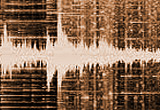
 I’m not sure how I managed to miss the term ‘acousmatic’ until now, but having found it, I have a whole new take on sound.
If I’d been one of Pythagoras’ akousmatikoi around 500 BCE, I’d have known about it. And if I’d been part of the musique concrète movement during the sixties, I’d have known about it. If you’re involved in radio, TV, movies or games, you need know about it too...
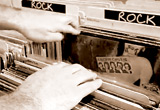 Before the internet, when each morning’s post brought a new pile of vinyl to my desk for listening and review, I came to regard the schoolyard as one of the music biz’s most underrated assets.
Here, boys (exclusively) shared the fruits of hours of bedroom listening. Personal musical explorations were enthusiastically pooled for the greater good. Later, commitments and kids would take it all away.
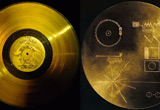 It was Fatboy Slim who first put me wise to the ‘democratisation of music’. In a staunch defence of music sampling’s domination of the late-’80s music charts, his arguments were a taste of things to come…
Major labels and big-room recording studios were struggling in the face of project recording and on-line distribution. Now, WholeWorldBand and Songkick Detour are offering fresh takes on music recording and gig promotion.
 Once again, it began as a throwaway Facebook exchange. Why, a Friend asked, do DJs have to invent new words and stupid spellings for everything?
Moving on from DJs posturing and muso disdain, there is a wealth of worth in the language of the music business. It is constantly evolving to define, enable and exclude, responding to events, technical advance and outside forces. And we need it as much as we need mics and mixers or ambition and opportunity…
 For most players, the ‘feel’ of an instrument is an intrinsic and essential part of its character and its use. It can even be the most important part of your relationship with a particular instrument. To separate sound and feel would be laughable – unless you’re a keyboard player.
We’ve done this twice to date. First, when we used electronic keyboards to imitate other instruments. And now we’re doing it again with ‘soft synths’.
 Two years ago, I blogged about apps ‘shaping future computer operation’. Not a bad call, on reflection – but I completely missed their potential role in ‘second screen’ television viewing.
Here the convenience and mobility of a tablet or smartphone conspires with a suitable app to become a companion device to live TV. Sounds trivial? Big broadcasters and serious numbers say that it’s not…
 Wanted: Keyboard player/tape recorder technician for BBC Radiophonic Workshop tribute band. Knowledge of British 1960/70/80s TV and strong technical background essential. Must be able to patch unreliable synthesisers, splice tape and change valves in live performance setting. No time-wasters, breadheads or planks.
No takers? No surprise, really... Yesterday’s World is no place for today’s Tomorrow People. Or is it?
 Midi has enjoyed a lot of press recently. In honour of its 30th birthday, it’s been in the news everywhere from tech blogs to the broadsheets, from Twitter to TV. And deservedly so...
Against the odds, Midi has provided electronic music making with its lingua franca and rewritten the future of electronic musical instruments and music making. Thirty years ago, it was 1983 and Midi changed my life.
 Just as a well-crafted thriller kicks up a gear when apparently unrelated threads converge, the collapse of UK music and media retailer HMV seems to have greater significance than ‘just’ the failure of another high-street shop in an economic crisis.
It feels designed. As if an unseen hand has pushed Nipper – presciently posed on His Masters’ Coffin – into the front line against the sinister forces behind the music download. And that a big reveal is just around the corner.
 Putting a new spin on the early work of Cecil Sharp and ethnomusicologists such as Alan Lomax and David Lewiston who have followed, Sabine Kämper has released Chorus and Cuisine – adding a unique culinary angle to the mission of documenting and preserving endangered music.
But she is not alone in her mission, or in taking on the technical challenges of remote field recording…
 The recent UK Reproduced Sound conference invested heavily in acoustic modelling and auralisation. Among the event’s speakers, conference chair Paul Malpas looked at ‘the role of auralisation in interdisciplinary design’, questioning the neglect of sound in the early development stages of buildings. Good man.
On the surface, it wasn’t an issue that should have needed raising at an acoustics conference. But if not here, then where?
 There’s a big problem with the Big Bang. A Big Audio Problem.
The background noise thrown up by the current rush of theories – p-branes, inflation, a bubble universe, multiple Big Bangs and their like – has drowned out the impossibility of a bang of any kind occurring where no gasses or fluids yet exist.
But then, you can’t believe everything you hear about sound…
 In the beginning was the word, and the word was analogue. Analogue shone on the world of sound recording, and it was good.
For a long time, good people made good music with analogue, and looked no further for their needs. But then a shadow fell across the face of the music makers. The shadow was cast by a new force called digital. It broke analogue’s spell, and the world was remade...
 The attitude to audio taken by TV advertisers and gamers could not be more contrasting, more telling – or more damning.
While advertisers eagerly lay claim to the term ‘creative’, their antagonistic stance on loudness betrays a small-minded regard for sound and its applications. Gamers, on the other hand, appear to be getting the most out of audio on all fronts. And that includes loudness…
 I could almost hear the gentle shuffle of feet and slow intake of breath while courage was gathered. A long pause. Then the news. A fellow audio journalist and good friend has been told that he needs hearing aids. It's a confession...
Another silence. It is an awkward moment at both ends of the phone. Although we are the press, we do audio. We love audio. The unspoken question, then – is it all over for him?
 There’s something offensive about TV ads. They run roughshod over our viewing and undermine the work of the many people it takes to make a feature film or television feature.
They do not extend the respectful invitation of print ads, designed to succeed on merit and message, but force themselves on us like party gatecrashers. They were the first terrorists of the advertising world…